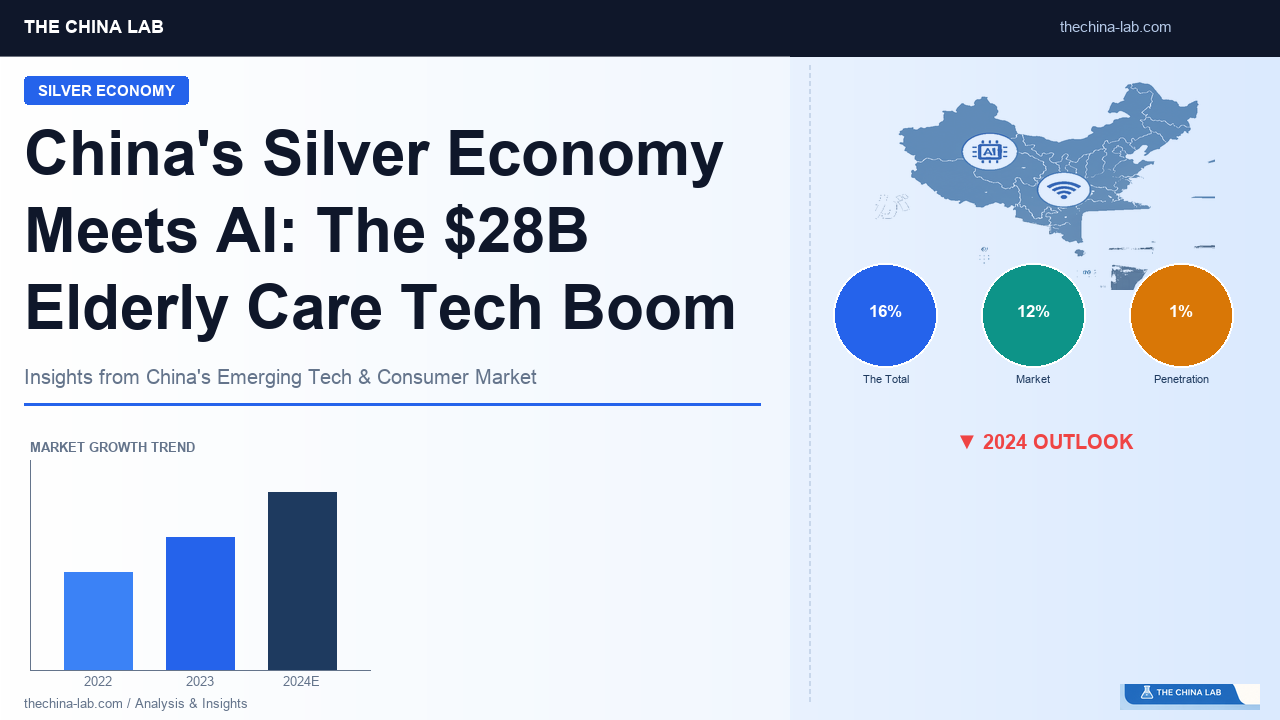
China’s Silver Economy Meets AI: The $28B Elderly Care Tech Boom
Why China’s Elderly Care Appliance Market Demands Attention Now
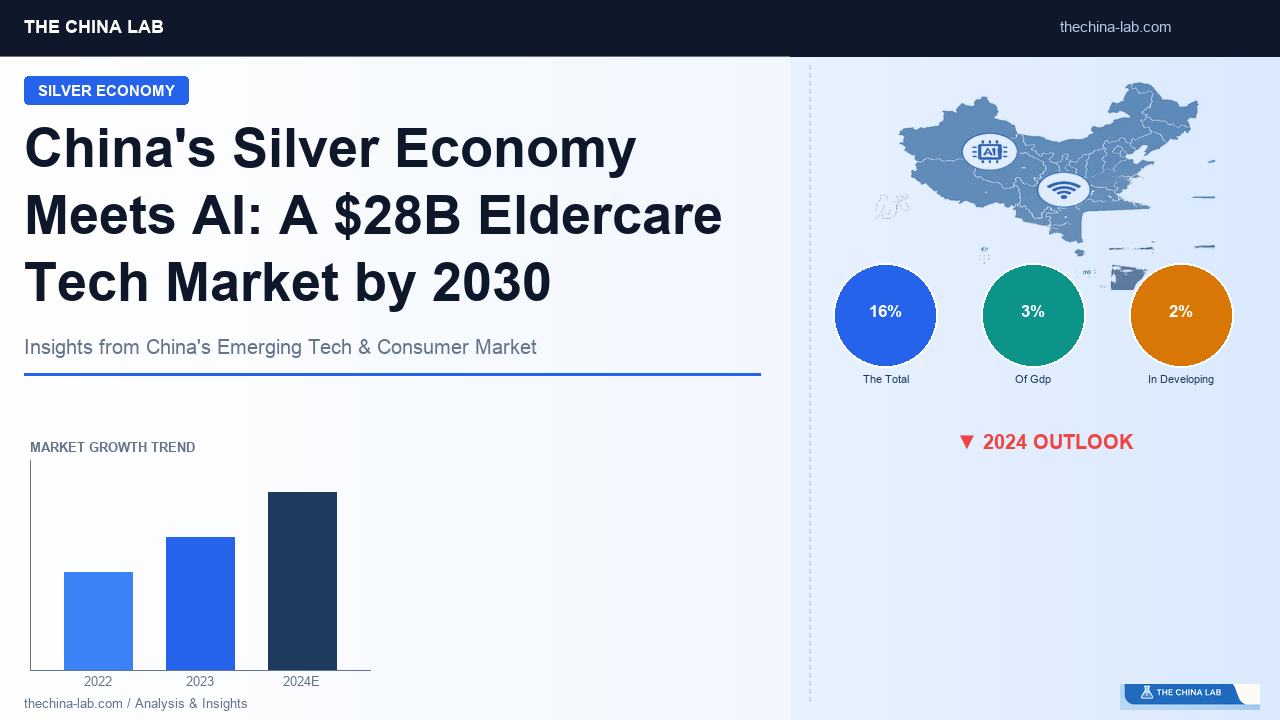
In 2024, China’s population aged 65 and above surpassed 220 million—roughly 16% of the total population. But the more striking development lies ahead: between 2027 and 2028, China will enter what analysts call a “leap period” of accelerated aging, as the generation born during the early-1960s baby boom reaches retirement age.
The challenge is compounded by a severe caregiver shortage. While approximately 40 million elderly Chinese require some form of assisted care, the country has only around 500,000 professional caregivers—an 80-to-1 gap that no workforce expansion can realistically close.
This structural imbalance is driving explosive growth in AI-powered care devices. A February 2026 report from Guosen Securities provides detailed projections for this emerging market at the intersection of China’s “silver economy” and artificial intelligence. The headline finding: the long-term global market for elderly care robots could exceed 200 billion RMB ($28 billion), with China’s domestic market alone accounting for nearly 60 billion RMB.
Elderly Care Robots: A 200+ Billion RMB Global Opportunity
Why Robots Are Taking Off Now
Three converging forces are propelling elderly care robotics from concept to commercial reality.
First, demographic necessity. With 40 million elderly requiring care and only 500,000 caregivers available, mechanical assistance isn’t optional—it’s inevitable. No amount of immigration or workforce training can bridge this gap within the relevant timeframe.
Second, technological readiness. Advances in AI, computer vision, and sensor technology have finally made care robots practical. Devices can now detect falls in real-time, monitor vital signs non-invasively, and even handle personal hygiene tasks with appropriate precision.
Third, policy support. In January 2026, eight Chinese government ministries jointly released the “Measures for Promoting Silver Economy Development,” explicitly identifying elderly care robots as a strategic industry. The policy specifically calls for advancing embodied AI and brain-computer interface technologies in care applications.
Market Size Projections by Region
Guosen Securities estimates the following long-term market potential:
| Region | 65+ Population (2030, millions) | Care-Dependent Rate | Robot Adoption Rate | Avg. Price (RMB) | Market Size |
|---|---|---|---|---|---|
| China | 289.2 | 17% | 30% | 20,000 | 59B RMB |
| United States | 78.0 | 15% | 50% | 60,000 | 70.2B RMB |
| EU | 100.0 | 15% | 50% | 60,000 | 90B RMB |
The combined long-term global market exceeds 200 billion RMB (approximately $28 billion at current exchange rates). Notably, while Western markets command higher unit prices, China’s sheer population scale makes it the largest single market by volume.
Three Types of Market Players
The report identifies three distinct categories of companies entering this space:
-
Vertical Specialists: Companies focusing on specific care needs with deep product iteration. Examples include Oushen Electric’s Illino brand (toileting care robots) and Rongtai Health/Ogawa (therapeutic massage robots).
-
Embodied AI Leaders: Humanoid robotics companies expanding into elderly care applications. UBTECH, Fourier Intelligence, and Zhiyuan Robotics are deploying general-purpose robots adapted for care scenarios.
-
Smart Home and Tech Giants: Established players leveraging existing ecosystems. Midea Group, Haier Smart Home, Huawei, and EZVIZ Network are integrating elderly care capabilities into their broader smart home platforms.
Three High-Growth Categories to Watch
Home Monitoring Devices: 14 Million Units Annually by 2030
Falls are the leading cause of accidental death among Chinese adults over 65, according to the China CDC. AI-powered monitoring devices have evolved beyond passive recording to active intervention—detecting falls in real-time, alerting family members, and connecting with local healthcare providers.
Key market indicators:
- 2025 consumer camera sales in China: 55.07 million units
- Fall-detection enabled cameras (400+ RMB price point): ~12% of market
- Elderly households living alone: projected to grow from 38 million (2025) to 60 million (2030)
- Projected elderly monitoring device market (2030): 14 million units annually (CAGR ~16%)
EZVIZ Network leads this category with its “EZVIZ Smart Elder Care” ecosystem, integrating four core functions: activity monitoring, health data tracking, safety alerts, and voice assistance. The company reported 2025 revenues of 5.9 billion RMB, up 8.4% year-over-year.
Care Robots: From Toileting to Therapeutic Massage
Oushen Electric’s Illino subsidiary has developed a toileting care robot that automatically detects bodily functions, processes waste, and maintains hygiene logs for bedridden patients. The device has already secured medical certifications in Japan, the United States, and the EU, with commercial sales established in Taiwan and Japan.
In the therapeutic segment, Rongtai Health plans to launch AI-powered massage robots in partnership with Meituan during the first half of 2026. These devices use 3D vision combined with AI to precisely locate acupuncture points and deliver personalized massage therapy.
AI Sleep Technology: The Sub-1% Penetration Opportunity
China’s bedding market reached 65.9 billion RMB in 2024 (approximately $9 billion). Yet AI-enabled sleep systems—not fixed-function smart beds, but products that use large language models for personalized optimization—have penetrated less than 1% of this market.
DeRucci (慕思股份), China’s leading premium bedding brand, reported AI product sales of 121 million RMB in H1 2025—more than triple the same period in 2024. The company’s “Tidal Algorithm 2.0” detects sleep position changes within 20 milliseconds and offers over 6,000 individualized support configurations.
Meanwhile, Sleemon (喜临门) has partnered with BrainCo, a brain-computer interface specialist, to develop AI bedding that uses non-invasive brainwave monitoring to actively optimize sleep architecture. This represents the frontier of sleep technology—systems that don’t just track sleep quality but actively intervene to improve it.
Strategic Implications for International Business
For Career Professionals
China’s silver economy represents a distinctive skill-building opportunity for international professionals:
-
Regulatory expertise is becoming scarce and valuable. Experience navigating China’s NMPA (medical device) certification, government procurement processes, and pilot programs will command premium value over the next decade.
-
AI × healthcare product management roles are expanding. Chinese elderly care tech startups increasingly seek collaboration with international partners who understand both technology and healthcare workflows.
-
Market intelligence matters. Professionals tracking companies such as Oushen Electric (Illino), EZVIZ Network, and DeRucci can anticipate market directions before they become consensus views.
For Companies
Several strategic responses merit consideration:
Update competitive analysis. Chinese elderly care robot and AI sleep manufacturers have already secured Western medical certifications and begun international expansion. Domestic players in developed markets should monitor these emerging competitors systematically.
Explore technology partnerships. Oushen Electric’s pivot—applying its existing manufacturing capabilities to elderly care—offers a template for mid-sized manufacturers in adjacent categories. Companies in cleaning equipment, pneumatic systems, and bedding should evaluate potential synergies.
Leverage policy-linked market entry. China invested approximately 3 billion RMB in home modification subsidies for aging-in-place improvements in 2024. Policy-aligned market entry strategies can access both direct subsidies and accelerated adoption among target customers.
Three Key Takeaways
-
The global elderly care robot market could exceed 200 billion RMB ($28 billion) long-term, driven by the irreducible math of 40 million care-dependent elderly and 500,000 caregivers. China’s domestic market alone represents nearly 60 billion RMB in potential.
-
Three categories show the highest growth trajectories: AI monitoring devices (16% CAGR to 14 million units by 2030), therapeutic and toileting robots (now achieving international certifications), and AI sleep technology (sub-1% penetration with triple-digit growth rates).
-
A rare alignment of policy, technology, and demographics creates near-term momentum. The January 2026 eight-ministry policy directive, national investment in embodied AI and brain-computer interfaces, and the 2027-2028 demographic inflection point together create an unusual window for market entry and investment.
→ Related: China Smart Home Market Trends | China AI Industry Report | AWE 2026 Highlights
Leave a Reply