China Smart Home 2026: Emotional Value Becomes the New Competitive Edge
Why Global Business Leaders Must Track China’s Appliance Evolution
The era when home appliances sold on specifications alone is rapidly ending in China.
A January 2026 report by global research firm Ipsos, based on quantitative surveys of 1,200 consumers across major Chinese cities, identifies ten structural shifts reshaping the smart appliance market. The central insight is striking:
Features are merely the entry ticket. Experience creates the moat. Emotional value drives premium pricing.
For international manufacturers, suppliers partnering with Chinese firms, and analysts tracking China-origin innovation, these changes demand immediate attention. The rules of competition are being rewritten.
The Core Shift: Emotional Value as the New Battleground
Spec Wars to Five-Sense Design
The Ipsos report’s most emphatic finding concerns a fundamental change in consumer decision-making:
- 88% of consumers cite functionality as a purchase consideration—but the definition has shifted
- Consumers pay premiums not for products that meet functions, but for experiences that solve life pain points
- 58% of users now say they seek emotional value via home appliances
What does this mean in practice? The report’s examples prove instructive.
The fragrance experience in laundry: One consumer comment stands out: The moment I pull clothes out of the dryer and that scent gently wafts up—that matters enormously to me. Miele’s aromatherapy function for dryers is no longer positioned as a bonus feature but as an extension of premium garment care philosophy.
Toshiba’s White Peach refrigerator: Rather than leading with slim profile, compact footprint, and high capacity as specifications, the marketing frames these as enabling abundant living even in a small urban kitchen—a lifestyle narrative, not a feature list.
Gen Z Accelerates the Emotional Consumption Trend
Generational change underlies this transformation:
- Gen Z represents approximately 20% of China’s population while commanding 40% of consumer spending power
- As digital natives, they prioritize emotional resonance and self-expression over functional adequacy
- 84% of consumers now consider appearance when purchasing appliances; 69% will pay more for superior design
For Gen Z consumers, appliances have evolved beyond household tools shared by the family to personal items expressing individual lifestyle identity.
By the Numbers: Five Data Points Defining 2026
| Metric | Value | Implication |
|---|---|---|
| Consumers prioritizing appearance | 84% | Design becomes the primary purchase driver |
| Willing to pay more for health features | 85% | Health represents the strongest premium justification |
| Consider smart features a baseline requirement | 76% | AI is no longer added value—it’s table stakes |
| Prefer built-in installation | 66% | Invisible appliance design dominates preferences |
| Strong demand for automation | 78% | Hands-free experience expectations surge |
AI Evolves beyond Smart Control to Anticipatory Service
The qualitative shift in AI expectations deserves particular attention.
Previous expectation: I can control my air conditioner remotely via smartphone app.
2026 expectation: The system detects when I drift off and automatically adjusts to optimal temperature, humidity, and quiet mode.
Consumers have grown tired of app-based control. The report captures this evolution with a phrase: The best interaction is no interaction.
COLMO’s AI Eye series automatically identifies fabric types and optimizes wash cycles accordingly. Fotile’s Ruiying Healthy CookingGPT combines 28 years of recipe data with user BMI and food allergy information to recommend personalized meal plans based on a database of 26,000 recipes.
Strategic Implications for International Business
Career Development Considerations
Skills becoming critical for professionals in China’s home appliance and smart home sectors:
- Emotional value design articulation: The intersection of UX design, kansei engineering, and market research
- AI product management: Moving beyond adding AI features to designing systems that eliminate the need for user intervention
- Local consumer insight expertise: As imported brand prestige fades, deep understanding of Chinese user research methodology gains importance
The report notes that the halo of imported brands is dimming, creating a window of brand affinity opportunity for domestic manufacturers. This applies directly to Japanese and Western brands. The assumption that Made in Japan or Made in Germany automatically commands trust is eroding. The new question: Does this truly fit Chinese daily life?
Business Strategy Recommendations
Immediate actions for international companies:
-
Replace specification comparison charts with lifestyle scenario content
On Chinese e-commerce platforms, content showing how this product transforms your morning 30 minutes drives higher conversion than feature lists. -
Evaluate subscription and XaaS business models
Delivering clean clothes or providing fresh air subscription models are gaining traction, with Electrolux and Blueair leading examples. The timing is right to seriously consider alternatives to hardware-only sales. -
Accelerate suite-based product strategies
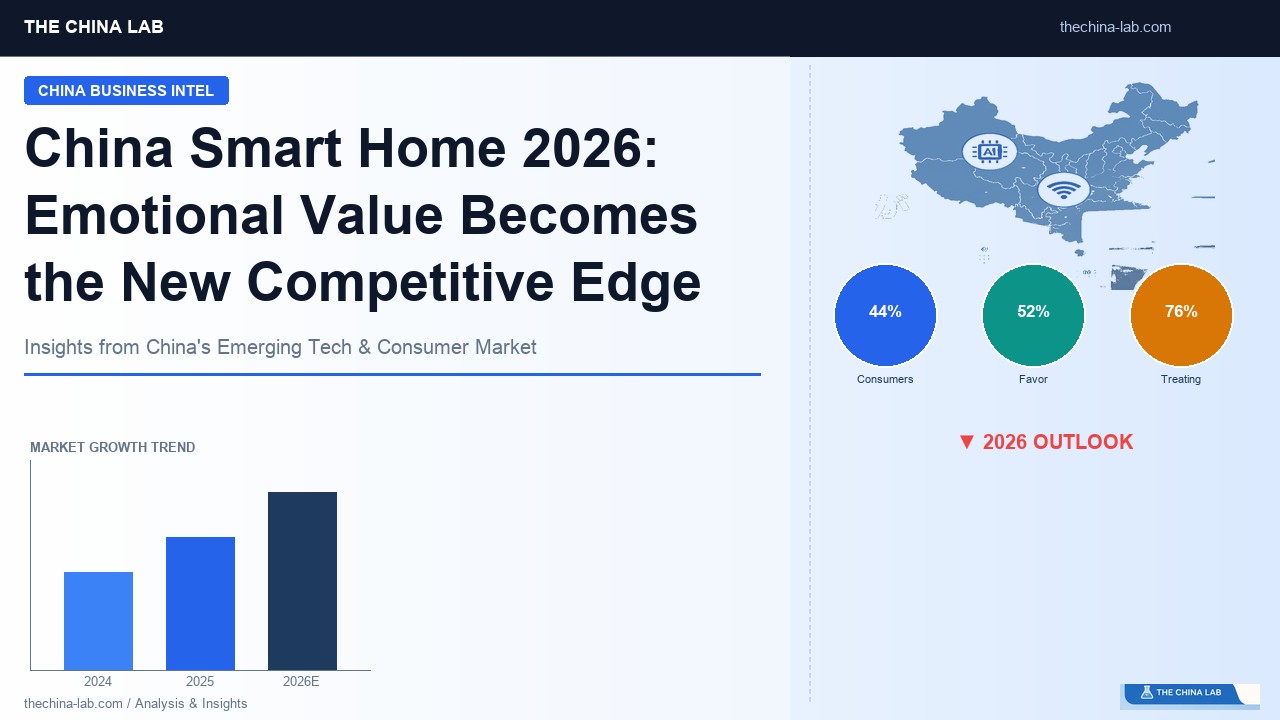
44% of consumers prefer purchasing through a single brand for aesthetic consistency; among new home buyers, 52% favor bundled purchases. Shifting past single-product sales to unified spatial aesthetics brand experiences has become urgent.
The Health Premium: Understanding Consumer Willingness to Pay
The survey reveals that health-related features command the strongest price premiums:
- 85% of respondents express willingness to pay more for health-enhancing functions
- Air purification, water quality, and food freshness preservation rank as top concerns
- Post-pandemic awareness has permanently elevated health considerations in appliance purchasing
This finding suggests that international brands with established credibility in health and hygiene categories retain significant competitive advantages—provided they can articulate these benefits within Chinese lifestyle contexts rather than relying on country-of-origin associations alone.
The Built-In Revolution: When Appliances Disappear
A design philosophy shift is transforming kitchen and living space layouts:
- 66% of consumers prefer embedded or built-in appliance installation
- The goal: appliances that disappear within the environment rather than dominating visual space
- This trend drives demand for standardized dimensions, custom cabinetry integration, and whole-home design coordination
For manufacturers, this means product development must increasingly consider installation partnerships, interior design collaboration, and modular sizing strategies. The standalone appliance—sitting prominently on a counter or floor—faces declining appeal among younger, design-conscious consumers.
Key Takeaways: Three Strategic Imperatives
-
Emotional value now justifies price premiums
Investment in five-sense experiences—fragrance, lighting, sound design, visual aesthetics—generates higher margins than feature competition. The functional specification race has reached diminishing returns. -
AI must evolve beyond usable to invisible
With 76% treating AI as a baseline requirement, consumer expectations have moved beyond reducing operations to anticipating needs and acting autonomously. International companies must redesign AI appliance strategies against this benchmark. -
Import brand advantages are fading; Chinese lifestyle fit becomes the sole differentiator
The brand halos of Made in Japan and Made in Europe are dimming. Purchasing decisions increasingly hinge on a single question: How well does this adapt to Chinese daily life?
→ Related: China Smart Home Market Trends | China AI Industry Report | AWE 2026 Highlights
Leave a Reply