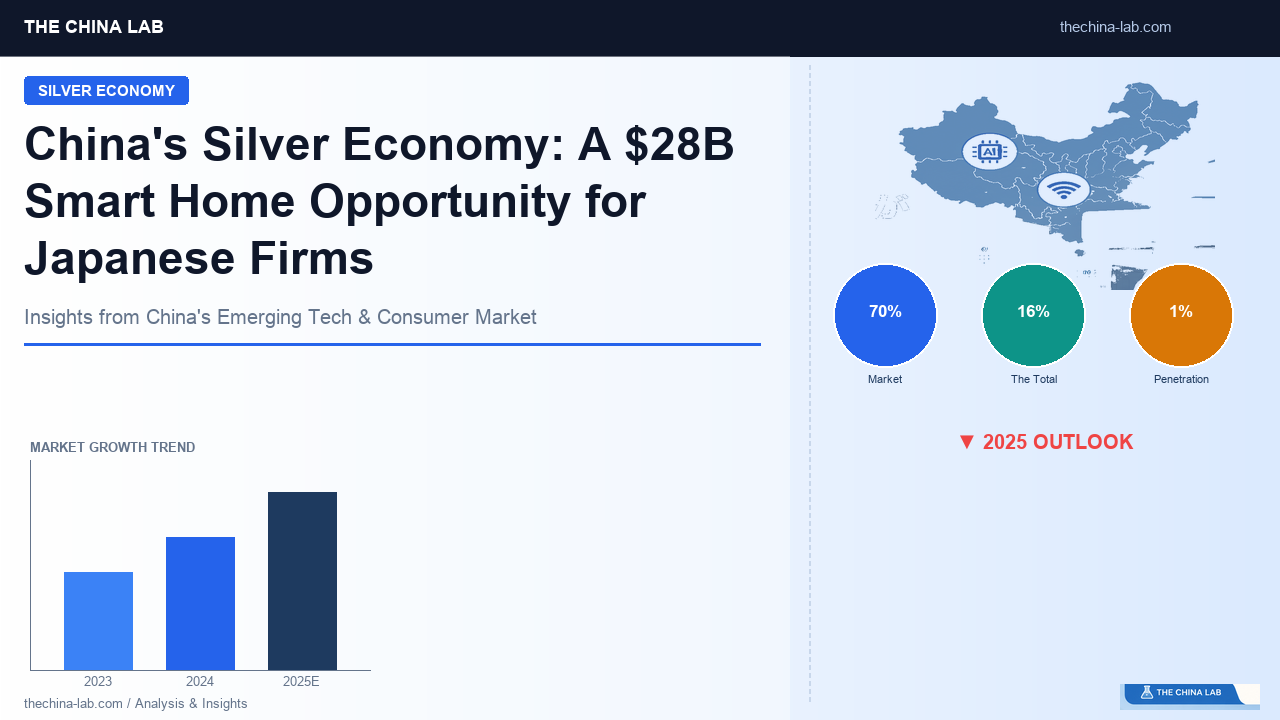
China’s Silver Economy: A $28B Smart Home Opportunity for Japanese Firms
Why This Market Demands Attention Now
China’s smart home appliance sector continues its impressive expansion. In 2025, the combined revenue of 28 publicly listed companies reached 1.014 trillion yuan ($140 billion), marking a 9.5% year-over-year increase. Yet for foreign companies eyeing this market, the window for general consumer electronics has effectively closed.
The Big Three—Midea, Haier, and Gree—now control over 70% of market share. Tech giants such as Xiaomi and Huawei have further consolidated the landscape through AI-integrated ecosystems that create powerful lock-in effects. Competing head-to-head in commodity appliances is no longer viable.
However, multiple securities research reports from China’s leading brokerages point to a significant exception: the silver economy represents a genuine blue ocean opportunity, especially among Japanese companies with established eldercare expertise.
The 2027-2028 Inflection Point: Understanding China’s Demographic Shift
The Scale of China’s Aging Population
China currently has 220 million people aged 65 and above—representing 16% of the total population. To put this in perspective, this demographic alone is nearly 1.8 times Japan’s entire population.
The trajectory ahead is even more significant:
- 2027-2028: China’s equivalent of the baby boom generation begins transitioning past age 75, triggering a surge in care-related demand
- 2035: The 65+ population will exceed 400 million
- Long-term market potential: The eldercare robotics and smart device sector alone is projected to surpass 200 billion yuan ($28 billion)
The critical insight here is timing. With the market’s major growth phase beginning in 2027-2028, companies have approximately 12-24 months to establish their position before the competitive landscape crystallizes.
Penetration Rates Reveal Massive Headroom
A Guosen Securities report highlights a particularly striking data point: AI smart mattress penetration currently sits below 1%.
These next-generation rest systems automatically track rest quality, heart rate, and body movement, providing continuous health tracking ideal for elderly users. Despite clear product-market fit, adoption in China remains in its earliest stages.
DeRUCCI , China’s premium mattress brand, recognized this opportunity early. In the first half of 2025, the company’s AI product revenue reached 121 million yuan—more than tripling year-over-year. Such explosive growth in a sub-1% penetration market demonstrates the sector’s exceptional potential.
Three Core Demand Categories in Silver Economy Smart Home
Category 1: Health Monitoring and Prevention
- AI smart mattresses (automated rest, cardiac, and movement tracking)
- Blood pressure and glucose monitoring integrated appliances
- Fall detection sensors with emergency alert capabilities
This category represents the strongest opportunity for Japanese eldercare technology firms. Japan’s position as the world’s most experienced aging society has produced superior sensor precision, fall detection algorithms, and rest analysis technologies that remain ahead of Chinese competitors.
Category 2: Daily Living Support and Labor Reduction
- Care robots (mobility assistance, bathing support, medication management)
- Voice-controlled appliances with simplified interfaces
- Smart TVs with large text displays and high-brightness screens
Chinese government subsidies and preferential tax policies for AI and eldercare robotics are actively shaping this market, creating favorable conditions for new entrants.
Category 3: Safety and Remote Monitoring
- AI cameras with behavioral anomaly detection for seniors living alone
- Smart locks with GPS integration for dementia patient safety
- Appliance usage monitoring (gas leak, forgotten-stove detection)
The need among adult children to remotely track elderly parents represents a universal challenge shared by both Chinese and Japanese families. Japanese companies have deep domestic expertise covering universal design principles, dementia care protocols—a proven track record giving them strong advantages throughout the Chinese market.
Strategic Implications for Japanese Companies and Professionals
Career Implications
Career paths intersecting with China’s smart home and silver economy sectors are positioned for rapid value appreciation. Demand will increase especially among professionals who meet these skill combinations:
- Eldercare technology expertise combined with Chinese language ability (bridging Japanese and Chinese care technology approaches)
- IoT device development experience applying China market knowledge
- UX design specialization focused on elderly Chinese users
roles at Japanese manufacturers’ China divisions and eldercare or medical device startups targeting China entry will see accelerated hiring as 2027-2028 approaches. Building China market intelligence and professional networks now represents a forward-looking career investment.
Business Strategy Options
Japanese companies should consider two primary market entry approaches:
Approach 1: Solution Export Model
Package technologies and products with proven track records in Japanese eldercare settings as Japanese quality with Chinese localization offerings. Pilot partnerships with Chinese eldercare facilities and real estate developers provide effective entry points. B2B channels targeting government procurement and institutional care facilities offer lower barriers and faster market establishment than direct-to-consumer strategies.
Approach 2: Component and Technology Supply Model
As major Chinese players such as Midea and Haier accelerate their eldercare robotics and smart home development, opportunities exist to supply high-precision sensors, motors, and safety-certified components. This approach builds stable revenue streams through supply chain integration without requiring direct brand presence in the market.
Risk Considerations: Intellectual property protection requires careful attention. Securing Chinese patent and trademark registrations before market entry is essential, as is rigorous contract design. Joint ventures involving technology transfer should proceed only after establishing robust IP protection frameworks.
Key Takeaways
-
The 2027-2028 deadline is real: China’s baby boom equivalent transitioning past 75 years old will trigger a care demand surge. The silver economy smart home market has 200+ billion yuan potential with current penetration below 1%—representing extraordinary growth headroom.
-
Japan’s eldercare technology advantage is genuine: While Chinese competitors dominate general appliance categories, silver economy smart home represents the most defensible differentiation opportunity for Japanese firms. Sensor technology, universal design expertise, and dementia care know-how constitute real competitive moats.
-
The immediate action item is partner identification: Initiating contact with premium Chinese companies such as DeRUCCI and Midea Healthcare during 2026 is essential for positioning pilot projects ahead of the 2027-2028 market acceleration.
→ Related: China Smart Home Market Trends | China AI Industry Report | AWE 2026 Highlights
Leave a Reply