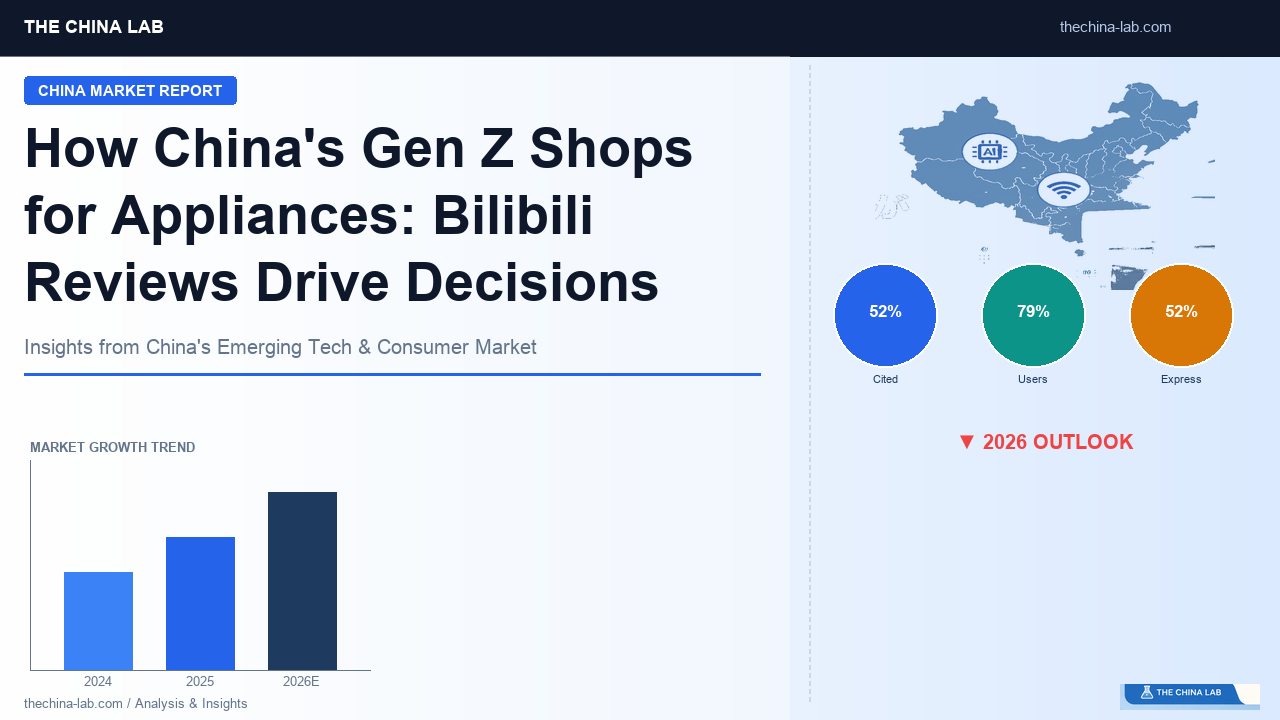
How China’s Gen Z Shops for Appliances: Bilibili Reviews Drive Decisions
Why This Matters Now
Trust real users, not advertisements. This shift in consumer behavior is happening globally, but in China, it has evolved to become something far more systematic and influential among young consumers.
In April 2026, video platform Bilibili (commonly known as B站) partnered with market research firm Ipsos to release the 2026 Young Consumer Smart Home Appliance Insights Report. Based on surveys of 1,500 users and extensive platform data, the report reveals how fundamentally the questions of who buys what, through which channels, and based on whose opinion have changed in China’s home appliance market.
For international businesses, investors, and professionals tracking China’s tech sector, understanding this transformation is no longer optional—it’s essential.
The Three Barriers Young Consumers Face When Buying Appliances
Barrier 1: Choice Paralysis due to Information Overload
Among the 1,500 Bilibili home appliance users surveyed, 52% cited fear of making the wrong choice and suffering financial loss as their primary concern. Additional findings paint a picture of widespread decision fatigue:
- 51% find reviews contradictory and don’t know which to trust
- 49% experience exhaustion due to endless comparison shopping
- 48% struggle to understand specifications across too many brands and models
The era when visiting a physical store could resolve purchasing decisions is over. Instead, excessive information has created a paralysis effect—what researchers call information overload syndrome.
Barrier 2: The Trust Gap Between Marketing and Reality
Distrust of official product descriptions and advertising runs deep. 79% of users trust user reviews on content platforms, while only 52% express trust in brand advertising.
More tellingly, 56% have experienced a disconnect between advertised claims and actual product performance. Consumers actively seek information about product limitations, drawbacks, and real-world usage constraints. The trust paradigm has shifted past brand-centric to user-experience-centric.
Barrier 3: Lifestyle Fit Challenges
The third barrier concerns whether products actually fit consumers’ real lives:
- 48% worry family members (elderly parents, children) won’t be able to use the product
- 42% find designs incompatible with their home interior aesthetics
- 42% struggle with overly complex personalization settings
High specifications mean nothing if a product doesn’t work for my home, my family, my taste. This emphasis on personal compatibility has become the defining priority for Gen Z consumers.
How Bilibili Became the Decision-Making Hub for Appliance Purchases
To overcome these three barriers, young Chinese consumers have turned to Bilibili. The platform’s growth metrics in this category are remarkable.
Year-over-year growth rates for Bilibili home-related topics in 2025:
| Category | Post Growth | View Growth |
|---|---|---|
| Smart Living | +66.96% | +128.54% |
| Smart Home | +401.48% | — |
| Smart Appliances | +277.42% | +145.12% |
| Quality Appliance Reviews | +159.09% | — |
The hashtag #家居整活大赏 (Home & Appliance DIY) has accumulated 810 million views, while #我在B站搞装修 (Renovating with Bilibili) reached 780 million views. Appliance choices and interior design have transformed past private activities to public community discussions.
Five Types of Review Content Driving Purchase Decisions
Five distinct review formats on Bilibili particularly influence consumer behavior:
- Specification Comparison Reviews — Objective side-by-side parameter analysis that resolves choice paralysis
- Teardown Reviews — Physical disassembly examining internal components, building foundational quality trust
- Long-term Experience Reviews — Authentic impressions after months of actual use, bridging the trust gap
- Scenario-based Reviews — Testing in real rooms with actual family situations, confirming lifestyle fit
- Entertainment Reviews — Engaging, viral-friendly formats that drive brand awareness
These review categories score between 8.29 and 8.30 out of 10 in overall value assessment, with 81% of users stating these reviews significantly influence their purchase decisions.
The Bilibili Trust Ecosystem: Understanding the Mechanism
What makes Bilibili’s influence different than YouTube or TikTok is its unique trust-verification system combining three elements:
Danmu (弾幕/Bullet Comments): Real-time comments that scroll across videos allow viewers to see immediate reactions of thousands of other users at specific moments. When a creator makes a claim, viewers instantly see whether the community agrees or pushes back.
Comment Sections: Extended discussions below videos in which users share their own experiences, ask questions, and debate product merits create a secondary layer of verification.
Sanlian (三連/Triple Engagement): The combined action of liking, tipping coins, and adding to favorites serves as a visible trust signal. High sanlian ratios indicate community endorsement.
74% of users report that these community interactions significantly increase their trust in review content. Trust isn’t built through video content alone—it’s constructed through the visible consensus of the community.
Implications for International Businesses
The Direct Path via Bilibili to E-commerce
The report reveals a critical finding: 79% of users say they’re likely to add a product to their consideration list after frequently seeing positive comments in danmu and comment sections across multiple videos.
More importantly, 27% then proceed to search for the exact product model on e-commerce platforms such as JD.com and Tmall. This represents a clear, measurable conversion pathway via community trust-building to direct purchase action.
Strategic Recommendations for Market Entry
For international home appliance and consumer electronics brands targeting the Chinese market, several actionable strategies emerge:
Invest in Creator Partnerships Beyond Traditional Advertising
Partner with technical review creators and long-term experience documenters rather than relying solely on official brand channels. Authenticity signals matter more than production value.
Integrate Community Engagement Metrics
Track danmu sentiment and comment section discussions as key performance indicators. Positive community consensus drives consideration far more effectively than view counts alone.
Encourage Post-Purchase Content Creation
Design campaigns that incentivize customers to share long-term usage experiences. These authentic testimonials carry outsized influence in the Bilibili ecosystem.
Develop Scenario-Specific Messaging
Create content addressing specific use cases: compact apartments, multi-generational households, aesthetic integration with popular interior design styles. Generic product features resonate less than lifestyle fit demonstrations.
Understand the Platform’s Unique Architecture
Bilibili’s trust mechanisms differ fundamentally compared to Western platforms. Marketing teams need platform-specific expertise, not just general social media skills.
Career Implications for China-Focused Professionals
For professionals building careers in China marketing or digital commerce, understanding Bilibili’s trust ecosystem represents an increasingly essential competency.
The ability to design and optimize the Bilibili seeding → community verification → e-commerce conversion pathway will be highly valued. This requires understanding not just content creation but community dynamics, trust signals, and cross-platform consumer journeys.
Professionals who grasp how danmu, comments, and sanlian combine to visualize and amplify trust will have a significant advantage over those who approach China digital marketing with frameworks developed for Western platforms.
Key Takeaways
-
Bilibili is the starting point for Gen Z appliance purchases — 81% trust Bilibili review content, and 76% acknowledge its direct influence on their buying decisions. As advertising trust declines, user-experience-based content has become the primary driver of consumer choice.
-
Trust emerges through the combination of content and community — Videos alone don’t build trust. The visible interaction between creators and viewers through danmu, comments, and sanlian creates a trust verification system unique to Bilibili. 74% of users say community interaction significantly increases their confidence in reviews.
-
The Bilibili-to-e-commerce pipeline is proven and measurable — Community consensus formation directly translates to product searches and purchases on JD.com and Tmall. Bilibili has evolved beyond a content platform to become a central node in China’s purchase decision chain.
→ Related: China Smart Home Market Trends | China AI Industry Report | AWE 2026 Highlights
Leave a Reply