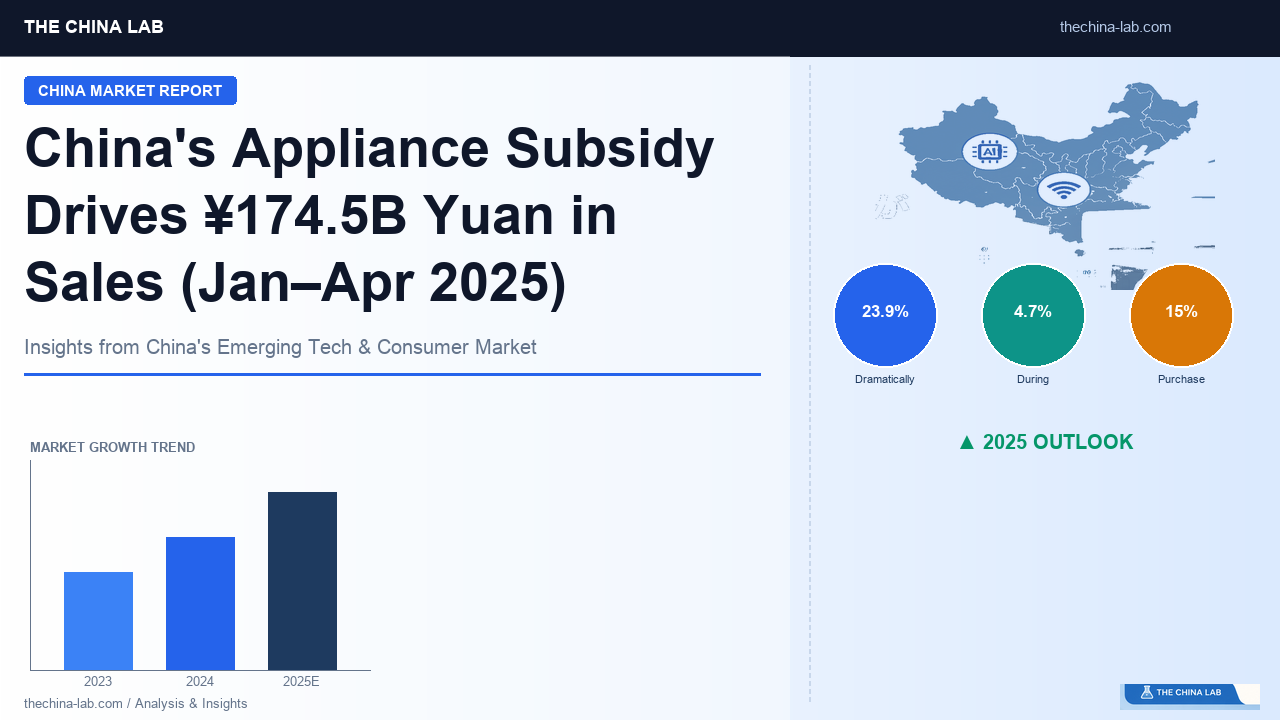
China’s Appliance Subsidy Drives ¥174.5B Yuan in Sales (Jan–Apr 2025)
Why China’s Home Appliance Market Is Surging
China’s home appliance sector is posting remarkable numbers in 2025, driven by an aggressive government subsidy program that has exceeded expectations.
According to China’s Ministry of Commerce, the appliance trade-in subsidy program (“以旧换新”) generated 174.5 billion yuan (approximately $24 billion) in sales from January through April 2025. The program attracted over 34 million participating consumers and moved more than 51 million units.
The momentum is accelerating. National Bureau of Statistics data shows April 2025 retail sales of home appliances and audio-visual equipment surged 38.8% year-over-year. The January-April cumulative growth of 23.9% dramatically outpaces China’s overall retail growth of just 4.7% during the same period.
What’s driving this explosive growth? Drawing on analysis from Guoyuan Securities, we examine the policy mechanics, demand dynamics, and corporate strategies reshaping China’s smart home landscape.
Policy Expansion Ignites Consumer Demand
Structural Shift: From 8 to 12 Eligible Product Categories
Understanding this surge requires examining the substantial policy expansion announced in early 2025.
The National Development and Reform Commission (NDRC) and Ministry of Finance jointly announced an expansion of subsidy-eligible appliance categories from 8 to 12 products. The program architecture rests on three pillars: equipment upgrades, consumer product replacement, and recycling infrastructure development.
More significant is the provincial-level supplementary support. Zhejiang Province announced on May 20, 2025 that smart home robots and smart glasses would be added to its subsidy program, offering 15% of purchase price up to 2,000 yuan per unit. This initiative extends through the end of 2027.
“Super National Subsidy Week”: Merging Online and Offline Retail
The policy’s impact has been amplified by innovative coordination between physical retail and e-commerce platforms.
Approximately 10,000 appliance and electronics stores nationwide partnered with Meituan Flash Purchase (instant delivery e-commerce) to launch “Super National Subsidy Week.” Major brands including Apple, Xiaomi, Huawei, Gree, and Skyworth participated, offering subsidies up to 20% plus additional coupons. The key innovation: products delivered within 30 minutes of ordering, a proposition that resonates strongly with younger consumers.
This model eliminates traditional friction points—the cumbersome process of verifying products in-store, then navigating complex subsidy applications. It represents a new paradigm for subsidy-driven consumption that other markets may seek to replicate.
Market Data: Smart Home Sector by the Numbers
Xiaomi’s Breakthrough: Washing Machine Sales Up 184%
The most striking corporate performance in China’s smart home market belongs to Xiaomi, which continues its aggressive expansion from smartphones into major appliances.
Key Q1 2025 metrics:
- Mijia-branded air conditioners, refrigerators, and washing machines ranked fourth nationally in unit sales
- All three categories exceeded 100% year-over-year growth in revenue
- Washing machines posted an extraordinary 184.4% increase
Xiaomi’s Wuhan smart appliance factory completed electrical installation 30 days ahead of schedule, with operations expected to commence in November. The facility targets annual production of 3 million air conditioning units by 2026, with total output value projected to reach 10 billion yuan by 2030.
“Going Global”: Indonesian Refrigerator Plant Signals ASEAN Shift
Parallel to domestic expansion, Chinese appliance manufacturers are accelerating overseas production.
Aucma announced in May 2025 plans to construct a refrigerator plant in Indonesia with annual capacity of 500,000 units. Total investment approaches 360 million yuan (approximately $50 million), with full operations targeted for 2028.
This shift from “exporting products” to “exporting production” represents an industry-wide trend. US-China tariff uncertainties have accelerated risk diversification through ASEAN localization—a strategic pivot that will reshape competitive dynamics across Southeast Asian markets.
Implications for International Business and Investors
Career Opportunities
The expansion of China’s smart home and appliance market creates several professional opportunities:
- Supply chain and procurement roles for component suppliers: Subsidy-driven demand is activating commercial discussions for parts, materials, and manufacturing equipment
- Cross-border e-commerce and retail consulting: The Meituan Flash Purchase model of instant-delivery subsidy fulfillment offers insights applicable to retail transformation in other markets
- Product management and engineering for IoT/AI devices: Demand for smart product development talent serving the Chinese market remains robust
Zhejiang Province’s decision to subsidize smart home robots signals that demand for professionals bridging AI and hardware will intensify significantly.
Strategic Considerations for International Companies
For businesses evaluating China market strategy, several action items emerge:
-
Map subsidy category expansion to product portfolio opportunities: The 12-category expansion creates addressable market entry points—assess which product lines align with policy support
-
Study the instant-delivery retail model: The integration of physical retail, national subsidies, and 30-minute delivery represents a potentially transferable innovation for consumer electronics distribution
-
Prepare for intensified ASEAN competition: Aucma’s Indonesian plant exemplifies the broader trend of Chinese manufacturers establishing Southeast Asian production. Early reassessment of ASEAN market strategies is advisable
Additionally, elderly care and aging-in-place applications represent an explicitly prioritized policy theme. International expertise in care robotics and assistive smart home technology could serve as meaningful differentiation in the China market.
Key Takeaways
-
Policy-driven demand is structurally reshaping the market: 174.5 billion yuan in sales generated January–April, with April retail up 38.8% YoY. This policy support framework extends through at least 2027
-
Chinese manufacturers are rapidly gaining competitive capability: Simultaneous domestic AI-enabled manufacturing and overseas production expansion (exemplified by Xiaomi and Aucma) will intensify global competition
-
Smart home sits at the intersection of AI, IoT, and aging demographics: Zhejiang’s addition of robots and smart glasses to subsidy programs signals that the definition of “home appliance” is expanding rapidly—creating both entry opportunities and competitive threats for international players
→ Related: China Smart Home Market Trends | China AI Industry Report | AWE 2026 Highlights
Leave a Reply